
News
Innovation Radar: Improving Websites by Neuroscience
How to improve user attention to your website? This is a crucial question because visitors decide in less than five seconds on whether to proceed and look further or to just click away.

Based on insights of neuroscience, the German company Whitematter Labs GmbH has developed EyeQuant, a patent-pending neurotechnology that helps companies optimize user attention.
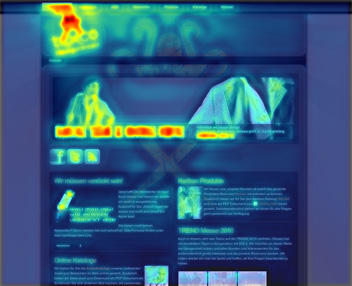
The web-based tools identify the most eye-catching elements of a website using a predictive neuroscience model of human attention. The technology is based on eye-tracking data gathered in studies with several hundred human subjects conducted by visual neuroscientist Peter Koenig and his Neurobiopsychology Lab at the University of Osnabrueck, Germany.
The analysis can be performed by uploading screenshots to the EyeQuant website and is answering crucial questions: what will users see at first glance? Which elements of the website garner most attention? What are the regions of interest?

Website owners will get a map of the eye-catching sections and a perception map of what potential customers will focus on within the first few seconds – and what they ignore. Based on these data, websites can be further improved and subsequently tested again.
The technology thereby helps companies and web designers to understand and optimize landing pages and to improve conversion rates. EyeQuant offers the free analysis of two website screenshots. More detailed analyses can be booked for projects or as a flat rate, but it is also possible to obtain the tools as white label or to integrate it in own websites and marketing tools.
[poll id=”3″]
Innovation Radar: A Game Changing Technology for Biomolecule Analytics
All biomolecules operate and interact in aqueous solutions, surrounded by a characteristic hydration shell. Virtually any conformational change of a biomolecule, e.g. the formation of a protein-protein complex or the binding of a small molecule, results in a change of the individual hydration shell.
A German company called NanoTemper Technologies has found a way to easily monitor these specific changes in the hydration shell and to derive quantitative information on interactions, conformational changes and macromolecular stability. The beauty of the concept termed Microscale Thermophoresis (MST) lies in its ability to observe and measure various parameters, such as affinities and binding energetics, at conditions which almost fully mirror the native environment of the biomolecules found in cells.
This is of great value, in particular for interactions that are difficult to access with standard methods, like the binding of small molecules or single ions to larger components of the cell, or the interactions of peptides and proteins to membrane receptors, the most important pharmaceutical drug targets.
NanoTemper, a spin-off from the Center of NanoScience (CeNS) at Ludwig-Maximilians-University in Munich (Germany), was founded in 2008. The company is headquartered in Munich and runs a fully owned subsidiary in San Francisco (USA). NanoTemper offers instruments and consumables to customers worldwide. The products provide scientists in basic research with cost-effective access to an enabling technology and allow experiments that have never been possible before. Pharmaceutical and biotech companies can use the technology for faster and better characterization of drug candidates. For more information visit www.nanotemper.de.
Pictured below: Monolith NT.115, one of NanoTemper´s Microscale Thermophoresis instruments
